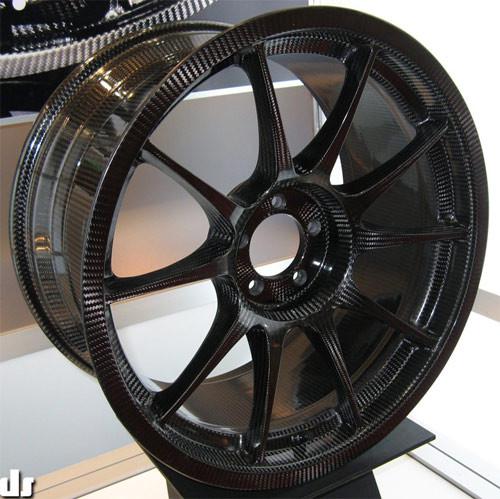
Weds Sport Full Carbon Fiber Wheel
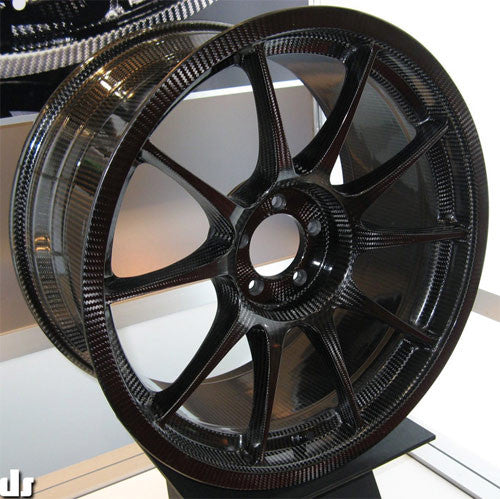
A Japanese company by the name of Weds Sport has come up with the first full carbon fiber wheel. They unveiled the wheels with what they call their Dry Carbon Wheel Project at the last Tokyo Auto Salon show.

One wheel weighs in at just 2.76kg, which works out to be 6.08475844 pounds. Interested in getting a set of these for your car? Expect to pay around $10,000-$12,000 for the set. While it sounds expensive, you can easily spend $8,000+ on custom three-piece forged wheels from a company like HRE.
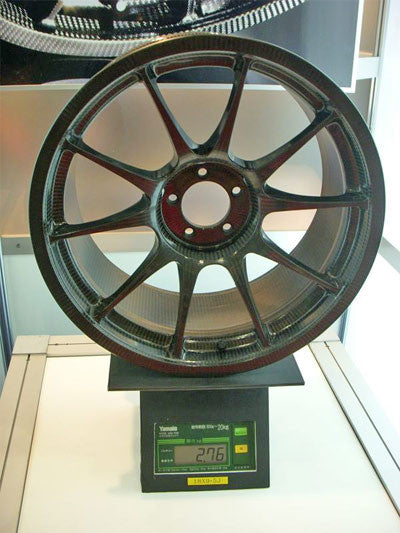
I tried to get somebody to translate the Japanese from the above display at Tokyo Auto Salon, but this was the best I got from user fithamoto on the Nissan 350Z forums:
Its kinda of complicated, but it basically says its a Dry Carbon Fiber process that can be used on automobile & motorcycle tires. Something about the weight and color too. It points out the differences between a wet CF proces & Dry CF process.
Sorry, really not much help after all. I guess your gonna need to get a first gen. Japanese to translate it correctly.
If anybody else can translate better, we’d love to know what the rest says…just post a comment below.
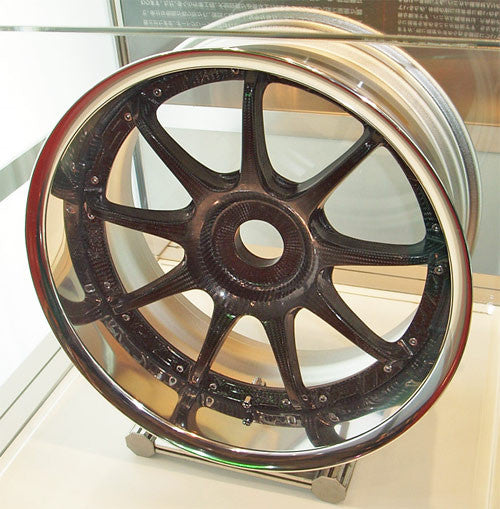
Weds Sport’s display also featured a wheel with a carbon fiber face, but more than likely a forged aluminum wheel surrounding. This is probably a much cheaper solution, and potentially arguably better looks.
There is some concern about a wheel being 100% carbon fiber that I’ve seen from people online…especially considering the weight of the wheel. Is it strong enough to support a car normally driving, let alone at a race track? What about the cost of repairing the wheel if something gets damaged? Does it need to get fully replaced, or can it be fixed for substantially less cost?
There is another company by the name of Dymag that makes carbon fiber wheels (which we’ll cover in a future post), but their hub is made out of magnesium. Apparently this is for strength reasons, which makes me think these fully carbon fiber rims should only be used for show cars. I’d like to hear Weds Sport’s thoughts on this. If you have any insight, feel free to post your comments.



michael martin
08/30/2008 3:06 amDo they make them for a Lada, if so I would be interested. They would make it good with the heated rear window so it would be lighter to push.
areel
09/03/2008 11:35 pmso wonderfull engineering
Andrew
09/06/2008 12:16 pmHi,
With todays technology in composites production they have the capability of making things we couldn’t have imagined several years back. Think about it, fighter jets pulling more then 7G’s, commercial jets with all carbon construction, F1 cars with nearly all carbon parts.
Pound for pound CF is MUCH stronger then steel or any alloys for that matter. If built properly they can very easily withstand the stresses it will encounter. The key word is built properly…. that would involve R&D to determine which manuf techniques and layups would yeild the highest physical propeties before failure of the part and then sticking with that method to produce your wheels.
Repair of composited after they have been damaged (for example by an impact) is a slippery situation. If it is purely a cosmetic part then sure, it’s not a problem. But if it is a critical stress bearing component then the risk of delamination is too much to even consider refurbishing a compromised part in my opinion, especially on a wheel. If we take a look at F1 for example, we see that they use CF all over the place except the wheels. The CF they make is for parts including chassis, wings, spars, pretty much everything except the wheels. Why? Couple reasons.
CF is incredibly strong and very light, a good mix for a race car. F1 uses CF in the nose cones and side impact zones as protection because of the characteristics of CF once it’s mechanical properties have been surpassed. CF delaminates, which is a fancy term to describe the seperation of the 2 components that are required to make CF parts, the resin and the matrix. The resin holds the matrix (the matrix being the dry carbon fibers) intimately close to itself and to the other fibers allowing the attractive forces to take over (just as a glue would). The thickness and geometry of these parts can be tailored to allow the impact areas to delaminate upon suffecient energy absorbtion. Now, given this characteristic of CF to delaminate (essentiall shatters into shards and dust, much like glass would) it is much too risky to use it for the wheels of an open wheeled race car capable of speeds in excess of 300km/h. Given the high potential for contact of all sorts in open wheel racing, I can’t imagine seeing a car traveling at those speeds and having it’s wheels delaminate from an impact and essentially turn into dust leaving only the rubber behind. But then again we see that the wheels are designed to break off from relatively minor impacts, the idea being that any impact that is suffecient in breaking the wheel off the car is likely also enough to do damage that might make it dangerous to continue racing even if the car seems fine to the driver. So perhaps there is a spot in F1 for composite wheels, but it is my guess that the cost of developing only a few wheels for prototype racing is too much even at the F1 level. Sorry for going off on a tangent…. back to the original wheels…
Ok so back to the situation of delaminating wheels… If these new carbon rims are strong enough to sustain the rigors of racing (which I would assue they are) then we only face one problem…. the risk of delamination from a very minor impact. In closed wheel racing the potential for contact is there aswell and the possibility of damaging the rims is there too. Now, given traditional rims made of alloys, upon impact these rims might crack but most likely they would suffer a bend. The driver would probably not even know the difference and continue the race if the rest of the car allows. If his tire starts to lose air then he might limp it back to the pits. On the other hand if he is racing with carbon rims and has an impact which instantly destroys the wheen so be it, we’ve all seen cars lose their wheels in a race or have it jam up inside the wheel well. The danger is when there is an impact to the rim that doesn’t destroy it immediately. Perhaps this impact only gives it a small crack and the driver doesn’t know that there is anything wrong and continues at race pace. With the presence of this crack the structural integrity of the entire wheels is compromised. The stresses that were once displaced over the entire structure of the rim are now being displaced over a wekend area aswell. This weak spot can instantly give without warning if the stress loads become too high. At full race pace if the wheel delaminates without warning or anticipation the results can be devastating (imagine a Senna type situation). This is probably the reason CF wheels are not allowed in racing.
Personally I would bet that these rims would be more then capable of handling the stresses that a race car would face during a race, but suffering an impact is the risk. I would also anticipate these wheels to withstand road use, if anything they would be overkill with physical properties much greater then their steel and alloy counterparts…. But until the company posts the stress test results or has them certified for road use under DOT etc. you can’t say with certainty. One thing is certain is that people saying carbon wheels are weak and will shatter at high speeds don’t know what they are talking about, the risk is only there once the integrity of the component has been compromised.
I love composites technology and I hope I made some sense. Sorry if I rambled on or got off topic
Thanks.
robert
09/16/2008 12:27 amHey poeples
this is to the people that are scared of the stuff and are worried these probably won’t be strong enough. Check out what manufactures are doing with CF in the cycling world, especially DH mountain bike, i have seen first hand how much abuse this stuff will take before it fails, and it is a scarey amount.
Dave
09/16/2008 11:52 amRobert - In the cycling world, do you know the carbon fiber wheels are 100% carbon? Or is the middle bearing part metal?
Justin
09/19/2008 7:47 pmCan you drag race, drift, or do time trials with these wheels.
Brent
09/29/2008 3:20 pmI don’t think you can say the first carbon wheels, they might be the first production wheels. Carbon wheels have been used in the Formula SAE competitions for 6 years now.
My workplace made a set of rear wheels for a 2000Hp drag car a few years back, first use all the studs holding on the wheels sheared off causing no damage to the wheels, studs have been upgraded and there have been no problems since. We have just finished a set of front wheels for the same car.
F1 can’t use carbon fibre wheels due the rules that wheels must be made from a homogeneous material, thus ruling out composites.
Dave
09/30/2008 9:13 amBrent - For the carbon wheels used in Formula SAE competitions, are they 100% carbon fiber, including the hub and surround?
Brent
10/01/2008 2:21 pm-I just noticed I had the wrong web address in my first post-
Dave - Some teams wheels are full carbon, such as Dekin University from Melbourne, Australia and Technische Universität Darmstadt from Darmstadt, Germany have full carbon wheels, other teams like RMIT also from Melbourne, Australia and Chalmers from Sweden have carbon rims with machined centres.
My team from the University of Auckland, New Zealand, are building a set of full carbon wheels with hollow spokes for next year the only metal will be the valve and wheel weights.
The design of carbon wheels isn’t really that complex, the load cases are relativity simple. We use FEA (finite element analysis) software called Hyperwork and Hypermesh, to model the loads and test different laminates, we also model the current aluminum wheels for comparison. This allows us to “test” different wheels without building any. Once made the wheels will undergo physical testing.
Anthony Carbone
10/01/2008 7:57 pmPure Carbon Fiber Wheels will never hit production cars nor will they last on any kind of performance racing vehicle or be able to withstand road forces due to the super high (unforgiving) tensile strength of Carbon Fiber.
A few large science companies are close to achieving the perfect balance of carbon fiber reinforced engineered polymers which will be able to withstand road going forces.
http://www.carzi.com/2008/02/14/carbon-fiber-wheels-not-the-ultimate-performance-material/
Brent
10/02/2008 3:44 amI agree that carbon wheels will not make it to every car, you just have to look at the number of companies that repair kerbed alloy wheels to see why.
The beauty of composites is that you can engineer your material properties and you’re are not stuck with one material. By using a standard modulus fibres the wheels will take a knock better, plus the fibres act to prevent crack propagation. Want a bit of flex (I don’t know why) put less fibre in that direction.
I’ve repaired carbon bikes that have crashed hard, none have disintegrated and often the rider finished the race or two before getting it repaired. But if you’re worried about rims disintegrating on failure, a layer of Kevlar will act as a safety net to make it to the pits, yes the air will go but the Kevlar will hold the pieces together.
Slide
10/16/2008 10:16 amI definetely think they are fake.
Firstly you barely can’t manage those tight radii with carbon fibres. And even if you do so it is far away from a lightweight design.
At the bottom of a spoke those fibres are doomed to crack when stress is applied the first time.
Secondly you need a kind of insert at the hub due to the weak pressure resistance of carbon fibre. This rim’s hub is soely pressed on carbon fibre which won’t last too long at torques of 100Nm+.
The weight of 2,76kg is a fake for sure! If you calculate those dimensions (19×10) down to a 13×6 Formula SAE rim (the only series running on self-developed cfrp rims) you would hit ~1100g.
Ok, this is achievable in FSAE with very very hard work, but you have to have in mind that this rim is supposed to run on a Nissan 350Z, weighing in at about 7 times of an FSAE car.
And last but not least: How to manufacture such a complex structure??
We once designed and manufactured a cfrp rim in 15×7 inches and had unbelievable problems laminating our 3-spoke rim without distortions of the fibre, now what about a 10-spoke rim? And this rim definetely hasn’t any fibre distortions.
And those spokes are definetely not hollow which will add an extra weight.
Will
10/18/2008 7:36 amI want a set of the ones with the carbon fiber face these wheels are sweet. Id be more than happy to test on track as wheel if need be. Awesome job designing these!
Alex Lichtenfels
11/14/2008 7:11 pmThose wheels are nice. I wouldnt keep them for a long time though due to crack propagation over time. I’ve seen many carbon fiber parts shear into pieces. Once you have a micro crack in that rim, all hell breaks loose without any warning.